Thursday, April 26, 2007

Acceleration #5


Today, we get an artillery on a cliff above the same camp as last time. Osama was spotted through a window seated on the toilet in his outhouse 400 meters away and 100 meters down from our spot. This time, our artillery is better than the one we used last time, firing shells at 100m/s. The question is, how high do we aim it? We’ll need a new formula for that.


0=asx2/v2•tan2θ+sxtanθ+ asx2/v2-sy


You can see how I derived that for yourself if you want. It uses the same variables as before, so now to plug the numbers in.


0=-9.8•4002/1002•tan2θ+400tanθ+(-9.8•4002/1002-(-100))

0=-9.8•160000/10000•tan2θ+400tanθ+(-9.8•160000/10000+100)

0=-9.8•16tan2θ+400tanθ+(-9.8•16+100)

0=-156.8tan2θ+400tanθ-56.8


Unfortunately, I don’t see it being easily factorable, so we put it through the quadratic formula.


(-b±√(b2-4ac))/2a

a=-156.8
b=400
c=-56.8


Let’s start with the addition version of it.


tanθ=(-400+√(160000-(4•-156.8•-56.8)))/(2•-156.8)

tanθ=(-400+√(160000-35624.96))/-313.6

tanθ=(-400+√124375.04)/-313.6

θ=8.582852416°


Now the subtraction version.


tanθ=(-400-√(160000-(4•-156.8•-56.8)))/(2•-156.8)

tanθ=(-400-√(160000-35624.96))/-313.6

tanθ=(-400-√124375.04)/-313.6

θ=67.38090412°


Well, it would’ve been nice to have one of the answers be obviously wrong, but it doesn’t always work that way. Let’s check both answers.


θ=8.582852416°

tanθ=(-400+√124375.04)/-313.6

0=-156.8tan2θ+400tanθ-56.8


You put the value of tanθ into the equation on the third line of that set, use your calculator, and you get


0=0


…which means θ=8.582852416° is a right answer. Wait, we’re not quite done yet. It’s always a good idea to check the other answer, too.


θ=67.38090412°

tanθ=(-400-√124375.04)/-313.6

0=-156.8tan2θ+400tanθ-56.8


You do the same thing again, putting the answer you got for tanθ into the equation. This time you get


0=0.000000002


Close, but not good enough to be a right answer.

Now we can aim the artillery 8.582852416° above horizontal, fire, and watch Osama’s outhouse get blown up.

Acceleration#5 - Derivation

OK, first I want to bring back 4 equations from last time…


sy=(1/2)at2+vyt+s0
sx=vxt
vx=vcosθ
vy=vsinθ


…and a trigonometric identity.


1/(cos2θ)=tan2θ+1


Now we can derive a new equation to fit what we’ll do today.


sx=vxt

t=sx/vx

t=sx/(vcosθ)

sy=(1/2)at2+vyt+s0


Since s0 is the origin, it equals 0 and would not need to be included.


sy=(1/2)at2+vyt

0=(1/2)at2+vyt-sy

0=(1/2)at2+vsinθt-sy

0=(1/2)a(sx/(vcosθ))2+vsinθ(sx/(vcosθ))-sy

0=((asx2)/v2)(1/cos2θ)+sx(sinθ/cosθ)-sy

0=(asx2/v2)(tan2θ+1)+sxtanθ-sy

0=asx2/v2•tan2θ+sxtanθ+ asx2/v2-sy

Monday, March 19, 2007

Force

A force is a push or pull on an object. It can be what you use to push a box across the floor, the gravity that pulls things down when they fall, or what keeps a maglev train floating above the track. An object can either use force directly like you do when you push the box, or as a field force like gravity and magnets. The difference is that the object that’s pushing has to touch the object that’s being pushed, but the field force acts from a distance. You’re probably expecting a formula, well here it is:


F=ma


…And here’s what it means: To find the force acting on an object, you multiply the mass of the object times its acceleration. That means force has a magnitude (size) and a direction.

Yes, there’s a special unit for force, too. If you multiply the units for mass and acceleration, you get Kg•m/s2 and


1Kg•m/s2=1N


If you have a 1 kilogram object and it’s accelerating at 1m/s2, a force of 1 Newton is acting on it.

But there’s always more than one force acting on an object. Say you were making a 1 Kg weight accelerate upward at 1m/s2. Here’s a helpful number:


9.81m/s2


That’s gravitational acceleration near sea level on Earth. The Earth’s gravity is pulling every kilogram down with a force of 9.81N. You’re actually pushing the weight up with a force of 10.81N. Both those forces together make a net force of 1N upward, so the 1 Kg weight can accelerate up at 1m/s2.


Mass

Mass is one of the basic ways of measuring things in science. Chemistry measures things in grams, physics likes using kilograms.


grams = g
kilograms = Kg


Many people use mass and weight to mean the same thing, but they are different. Weight is actually a force and can change while mass stays the same.

Thursday, March 15, 2007

Valence Electrons

You know how atoms can link together? Well, these’re what let them do that and what says how many they can link to, too. The valence electrons are just the outside layer, atoms can give, take and share them. Check this out, you can tell how many an atom has just by looking at the periodic table.

The first column has one valence electron, all the ones from the second to the twelfth have 2, and the rest have 10 less than the column they’re in. That means an empty outer layer has 0 and a full outer layer has 8… Well, except for the first row, the hydrogen and helium, they can have either 0 or 2. All the atoms want either an empty or full outer layer, so they link to other atoms (it’s actually called a bond). Depending on what you have, the atoms can make up to 3 bonds to any other atom. Watch this, we have water, 2 atoms of hydrogen and 1 of oxygen.

Each hydrogen has 1 valence electron


And each oxygen has 6


Each hydrogen wants one and the oxygen wants two. How do we do this? Why, let’s have them share. The hydrogens bond to the oxygen, and everyone’s happy, all the atoms have full outer layers and I have something to drink.


…But hydrogen’s the only atom left of carbon that wants more electrons. The others are looking to get rid of their electrons. This time we use the kind of salt you put on food (there’re actually other kinds, too).

Sodium has one valence electron


And chlorine has 7


The sodium wants to get rid of one and the chlorine wants to find one more, so the chlorine takes the sodium’s electron. Now the sodium emptied its outer shell and the chlorine has a full one because they bonded together.

Saturday, January 06, 2007

Playing With Numbers

OK, today I was in the shower, playing with numbers in my head, when I had a sort of revelation about the number 6. I've finally finished a set of thoughts about 3, 6 and 9.

For 3
Pick a number, any number. Now split the whole sequence of digits into 1-digit numbers. If you don't get a 1-digit number after adding, keep doing it again until you do. If you end up with a 3, 6 or 9, you started with a multiple of 3.

For 6
Take the number you started with. If it's even and it fits what you did for 3, it's also a multiple of 6.

For 9
OK, now you take a number, you separate it into individual digits and add them together. If the number you end up with has more than 1 digit, do it again until you do end up with a 1-digit number. If that number is 9, you started with a multiple of 9.

Monday, December 04, 2006

The Atom

Atoms are the basic units of any element.

Atoms are made up of other smaller things, though, called subatomic particles. There are three main types of subatomic particles and many other minor particles.

The three major particles in any atom are protons, neutrons and electrons. Protons and neutrons are big (compared to the others) and form a cluster in the middle called the nucleus. All the protons have a positive charge and the neutrons have no charge.

The electrons are about 1/1000 as big as the protons and neutrons, but have the opposite charge of the proton. Their charge is the same strength as the proton’s charge, except electrons are negative. Electrons orbit outside the nucleus really fast and are really far away when you compare it to the size of everything in the atom.

There are over 110 elements. Most of them happen naturally, some of them were created by people. Each element represents all the atoms that have a certain number of protons.

Monday, November 20, 2006

Acceleration #4


Now we get to find where something lands after being launched, but first, there’re a couple new things to learn.


sy=s0+vyt+(1/2)at2


That works for the up-and-down direction. You can get a time from that and use it to find the distance in the horizontal direction.


sx=vxt


I’ll explain what the new variables mean. s0 is the starting position, sy is how far up or down it ends up, sx is how far forward the object travels. vy is the vertical (up-and-down) part of the object’s velocity, vx is the horizontal (front-and-back) part of its velocity. Oh, yeah, you’ll usually get the speed (v) and angle (θ) the object gets shot at. Don’t worry, I’ll tell you how to get something useful out of that, too.


vx=vcosθ
vy=vsinθ


For today’s practice, we get an artillery out in Iraq (not really, but we can pretend, can’t we?). It’s aimed in the direction of terrorist camp a kilometer (1000m) away. The artillery is aimed at 30˚ above the ground and fires at 50m/s. Do you think we can hit it?


vy=(50sin30˚)m/s

0=0+(50sin30˚)m/s•t-1/2•9.8m/s2•t2

0=-4.9t2+50tsin30˚+0


This equation doesn’t factor neatly, so it’d be easier to use the quadratic formula on it.


(-b±√(b2-4ac))/2a

(-50tsin30˚±√((50tsin30˚)2))/-9.8

(-50tsin30˚±(50tsin30˚))/-9.8


So you get 2 answers for t.


0s
(100sin30˚/9.8)s


You have to choose one, and 0s would mean it got launched and landed at the same time, so the second answer must be the right one. Now to use the time the shell stayed in the air to figure out how far it went.


vx=(50cos30˚)m/s
t=(100sin30˚/9.8)s

sx=(50cos30˚)m/s•(100sin30˚/9.8)s

sx=220.924847904193532337684482334933m


So the artillery shell only went about 221 meters, not far enough to hit the camp. There was a cool explosion, though. We’ll just have to come back next time with a more accurate way to aim and a better artillery.


Sine and Cosine

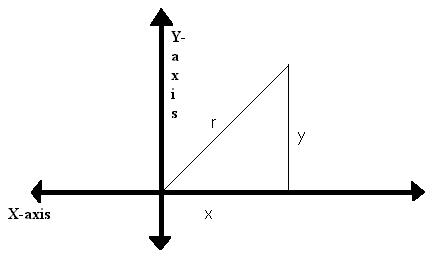
Before going on to the next post about acceleration, I need to explain sine (sin) and cosine (cos). First, let’s take a triangle. This one will do nicely.


You need to have a standard set of directions, though, so let’s put the triangle on a set of horizontal and vertical axes.


On the first triangle, you can measure sine and cosine from either point A or point C. The little letters a, b and c stand for the lengths of the sides. A and C also get numbers, the size of the angles in degrees. Now how do they all relate to each other?

sinA=a/b
cosA=c/b
sinC=c/b
cosC=a/b


Back in trigonometry (or was it algebra?) the teacher taught us an acronym: SohCahToa. That says three things. Number one, sine equals opposite over hypotenuse. Second, cosine equals adjacent over hypotenuse. Lastly, there’s tangent, but I’ll write about that later. Now, about the triangle I drew on the axes, that’s what I wanted to get to because that is the best one for what I’m going to put in the next post. On that triangle, you always measure from the origin, the place where the two axes cross, and you use the Greek letter θ (theta) to stand for the size of the angle. You only need two things for that triangle.


sinθ=y/r
cosθ=x/r


They’re the same as on the first triangle, just with different names for the variables.

Wednesday, November 15, 2006

Acceleration #3


OK, yesterday we looked at how fast an object will go a certain amount of time after being dropped, but what if we were to throw it? The formula form yesterday will work on something that gets thrown, but it only works to measure the speed straight up and down.

First let’s throw a grape down off the same building as yesterday. Let’s throw it at a speed of 5m/s downward (v0=-5m/s) and wait 3 seconds to measure its velocity (t=3).


v=-5m/s+(-9.8m/s2•3s)

v=-5m/s+(-29.4m/s)

v=-34.4m/s


So 3 seconds after being thrown, the grape is falling at a speed of 34.4m/s. Next, we find a convenienly placed cannon on the roof of the building. There’s enough gunpowder in it to launch a watermelon straight up at a speed of 15m/s (v0=15m/s). Let’s launch the watermelon and measure its velocity after 2 seconds (t=2s).


v=15m/s+(-9.8m/s2•2s)

v=15m/s+(-19.6m/s)

v=-4.6m/s


So when we measured the melon’s velocity 2 seconds after launching it, it was already starting to come back down and was moving at 4.6m/s downward.

Tuesday, November 14, 2006

Acceleration #2


Now that we have the concept of acceleration, we can use it to do more than simply tell how fast something’s velocity changes. This time, we take a look at how fast something’s falling based on how much time’s passed since it started falling, but first there’re a couple things you shold know.

The higher an object’s cross-sectional area to mass ratio, the lower its terminal velocity. What that means is that if you have a pencil (something that weighs a lot for the area air hits), it can fall faster than a parachute (something that has a lot of area for the air to hit compared to its weight).


g=-9.8m/s2


The gravitational acceleration near Earth’s surface is about -9.8m/s2, meaning that things accelerate by 9.8m/s2 toward the ground when they fall. Next, we need a formula.


v=v0+at


v is the velocity when you finish measuring it. v0 is the velocity when you started. Today, we’ll simply let go of the object, so we can ignore that part. a is the acceleration, and t is the amount of time that passed. Great, now we can calculate something. Say I were to stand on top of a tall building, let go of a ball over the street, and hope there weren’t any people down there. How fast would it be going after 5 seconds? (It’s always a good idea to put your units just to make sure nothing gets messed up.)


v=0m/s+(-9.8m/s2•5s)

v=-9.8•5ms/s2

v=-49m/s


Remember a negative is either left, back, or down. The ball has a velocity of 49m/s down 5 seconds after being let go. I sure hope no one was down there or I’m going to jail.


Wednesday, November 01, 2006

Acceleration

When it’s used in regular conversation, accelerat means to speed up. In science, though, it means a change in velocity. You can use it with numbers and direction to tell whethersomething is moving faster or slower in any direction.

Acceleration is just how much the velocity changes every second.


m/s2


So, you divide how much the velocity changes by how much time it takes to change. One more thing, if you slow down, the change is a negative number. Here’s an example:

Say you’re driving a car at 10 m/s and you decide to stop. You push on the break and stop in 2 seconds. Since you slowed down from 10m/s to 0m/s, the change in velocity is –10m/s.


(-10m/s)/2s

-10m/2s2

-5m/s2


So your acceleration was -5m/s2.

Wednesday, October 25, 2006

Velocity

Now that we have some basic units to work with and a way to measure displacement, the next thing we can do is measure how fast something’s going.

Normal Americans measure speed in miles per hour, mph. All that is is a distance divided by a time. It works the same way in science, you only use different units. In science problems, you use meters for the distance and seconds for the time. Now you can divide meters by seconds.


m/s


Now you can easily put in numbers and divide them. As an example, let’s say you can run the 100 meter dash in 10 seconds. To find out your speed there, you just divide the numbers


100m/10s

100/10=10

10m/s


So, you ran an average of 10 m/s in that race. It’s as easy as that.

Thursday, October 19, 2006

Basic Units in Science

There are several basic units you use to measure things in science.

Meters

A meter is the basic unit of distance in science. It’s about 40 inches.

Liters

A liter, or litre if you’re British, is science’s basic unit for volume. It’s equal to 1,000 cubic centimeters (cm3).

Grams

These are the basic unit of mass, although physics normally uses kilograms. Grams, however, are not to be used as a unit of weight as I’ll explain later.

Kelvin

The basic scientific unit of heat is the Kelvin. 0 K is absolute zero, or –273.15˚C. In other words, it’s the total absence of heat. Other than that, Kelvins and Celcius work the same way.

Seconds

You need a way to measure time, right? Well, so does science. Scientists use the second as the basic unit of time.

Wednesday, October 11, 2006

Distance and Displacement

In physics, there is a difference between distance travelled and displacement. Distance travelled is obvious. It’s just how much you travelled, like an odometer on a car.

Displacement is simple, too. It’s how far you end up from where you started.

Here’s an example: Say you rode in a car that went 100 miles east and then 100 miles west. The distance you travelled will be 200 miles, right? That’s because you went 100 miles and then another 100 miles. Interesting thing, though, you wound up back where you started. Since you finished your trip 0 miles from where you started, you have a displacement of 0 miles.